Showing posts with label materials. Show all posts

Monday, October 17, 2016

Enric Ruiz-Geli (Cloud 9) Lecture 20th October


Enric Ruiz-Geli (Cloud 9)
Media ICT and El Bulli
Thursday 20th October, 6pm
Robin Evans Room (M416)
University of Westminster
Department of Architecture


Enric Ruiz-Geli is an architect based in Barcelona who works with a group of collaborators and researcher’s as Cloud 9. Enric works at the interface between architecture and art, digital processes and technological material development. The architects’ multifaceted projects include stage designs and buildings, installations and technical patents. In 2011 he was awarded the prize for best building by the World Architecture Festival (WAF) for his groundbreaking net zero-energy building project ‘Media-ICT’ in Barcelona, which featured bioluminescent fireproof paint and an interactive smoke filled ETFE wall.


Key projects of Enric Ruiz Geli / Cloud 9 include the Villa Nurbs in Empuriabrava, an organically formed, ecological and futuristic house; Media-ICT building in Barcelona and the elBulliFoundation for the chef Ferran Adrià. Designed as a living laboratory in Cap de Creus on the Spanish/French border, the elBulliFoundation (culinary institute) is designed to sustainably regenerate its site within a national park using a mixture of ancient and contemporary environmental design strategies and is being developed in partnership with the national parks authority.


For details contact Will McLean - w.f.mclean@westminster.ac.uk

Technical Studies website - www.technicalstudies.tumblr.com


Wednesday, March 9, 2016

Fab Fest 2016 Registration Open


Fab Fest is a new International Fabrication Festival hosted this summer by the Faculty of Architecture and the Built Environment and the Fabrication Laboratory at the University of Westminster. It will feature 50 or more innovative cardboard pavilions designed and built by students from Westminster as well as by guest teams from across the UK and around the world.

Feb Fest will run from June 28th - July 2nd.

You can find more information about the brief and how to register here.

Friday, December 11, 2015

Aerocene metallic orbs by Tomás Saraceno in Paris' Grand Palais

"By releasing hot air from inside the Aerocene globes, pressure can be regulated and the altitude of the orbs can be controlled. They could also float along natural jet streams, using these as a way of changing direction."

from dezeen.

Wednesday, October 28, 2015

'Air Structures' and 'Deployable Structures' Book Launch: 9th November


Deployable Structures by Esther Rivas Adrover.

Deployable structures can expand and/or contract due to their geometrical, material and mechanical properties - offering the potential to create truly transforming environments. This book looks at the cutting edge of the subject, examining the different types of deployable structures and numerous design approaches. Filled with photographs, models, drawings and diagrams, Deployable Structures is packed with inspirational ideas for architecture students and practitioners.


Esther Rivas Adrover has experience as an architectural practitioner and educator. After teaching Advanced Descriptive Geometry to architecture students in Spain she studied architecture at Oxford Brookes University where she later taught at degree and postgraduate level. Her interest in complex geometries led her to work for practices including Zaha Hadid Architects, where she worked on various projects in the UK and around the world. She has also exhibited her own work several times at the Royal Academy of Arts in London.


Air Structures by Will McLean and Pete Silver.

Air can be used in a variety of ways to make lightweight, flexible structures. Filled with photographs, models, drawings and diagrams, this book looks at every facet of the subject, examining air-beam structures, air-cell structures, buoyant structures, inflatable structures and many more. It also looks at the construction methods that use air, such as air-inflated steel and aerated concrete.


Will McLean and Pete Silver teach at the Faculty of Architecture and the Built Environment at the University of Westminster and are the co-authors of Fabrication: The Designers Guide (2006),Introduction to Architectural Technology (2013), and Structural Engineering for Architects (2014). They both trained in the Architectural Association under John Frazer, where Pete later taught. They also established pioneering courses on real-time environmentally-responsive systems at the Bartlett (University College London).

Monday 9th November 6pm, Room M416
University of Westminster
Department of Architecture
35 Marylebone Road
London NW1 5LS
Room: M416
Nearest Station: Baker Street

Friday, October 16, 2015

Sound Installation in Estonia by Birgit Õigus

At Pähni Nature Centre in Estonia... "art academy students have developed and set up huge wooden megaphones to make the never-ceasing but scarcely noticeable calls and movements of forest inhabitants completely audible. The student Birgit Õigus designed the funnel-shaped megaphones for a project in the "Outdoor" auditorium at the academy. Hannes Praks, Head of the Interior Architecture Departments, explains, 'Being three metres in diameter at their widest point, the megaphones create a bandstand for the sounds that the forest produces.' Visitors can settle down comfortably inside the megaphones to enjoy the surreal backdrop of sounds."

more at DETAIL blog.

Wednesday, October 7, 2015

Aesop Store by Tacklebox


In this video Jeremy Barbour of Tacklebox explains the approach to the design of the Nolita Aesop store.

See more of Aesop's Taxonomy of Design videos here.

Thursday, August 6, 2015

Featherweight fibre-reinforced Pavilion by Suttgart University researchers


"The latest in a series of research pavilions in Stuttgart has now been realised. Taking its approach and design from the field of bionics, the 2014/2015 version is inspired by the way in which the diving bell water spider constructs a reinforced air bubble to survive under water....In this year’s case an initially flexible pneumatic formwork was gradually stiffened by reinforcing it with carbon fibres from the inside.

A film on the project and further information can be accessed here."

from DETAIL.

Saturday, April 25, 2015

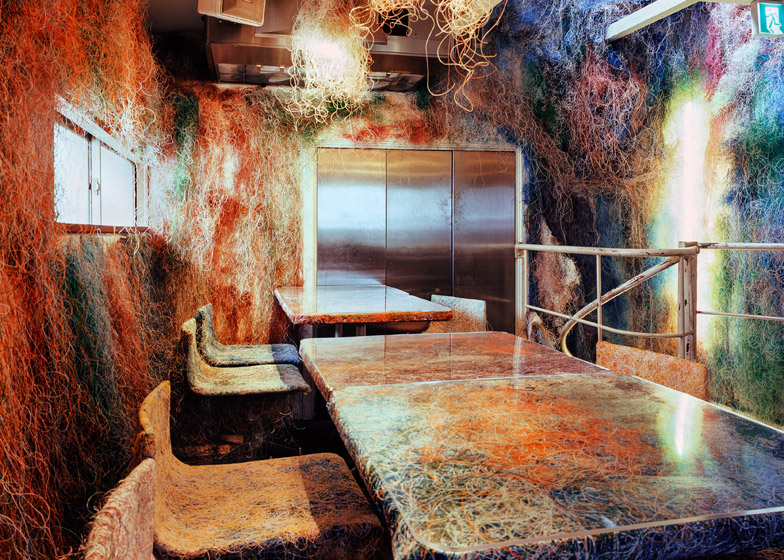
Tokyo Bar by Kengo Kuma


"Tufts of brightly coloured electrical cabling give the walls and furniture of this bar by Japanese architect Kengo Kuma a hairy appearance. The tangle of rainbow-hued wires drapes down the walls, over table-tops and chair backs, and around light-fittings in Tetchan – a bar that serves grilled meat skewers known as Yakitori."

more at dezeen.

Thursday, March 5, 2015

New book: 'The Material Imagination', edited by Matthew Mindrup


"As an alternative to a formal approach in architectural design, this book challenges readers to rethink the reverie of materials in architecture through an examination of historical precedent, architectural practice, literary sources, philosophical analyses and everyday experience. Focusing on matter as the premise of an architect’s imagination, each chapter identifies and graphically illustrates how material imagination defines the conceptual premises for making architecture."

Tuesday, October 28, 2014

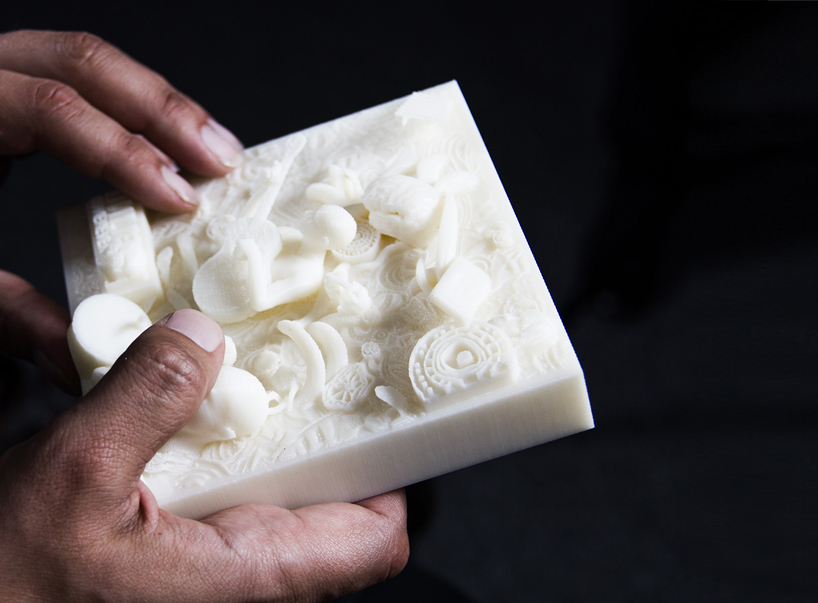
3D Printed "Touchable Memories" by pirate3D


"‘touchable memories’ by pirate3D, turns photographs into 3D-printed objects for people without vision. the social experiment project aims to increase the awareness of the endless possibilities of using technology to improve lives. using an affordable home printer called buccaneer, the visually-impaired can re-experience images by fabricating a tangible scene of it."

from designboom.

Sunday, September 21, 2014

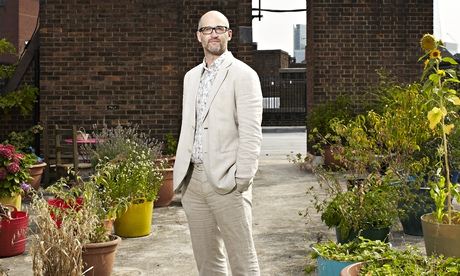
Mark Miodownik


'Everything is made of something' 


Mark Miodownik, director, The Institute of Making, University College London, and author of 'Stuff Matters'

' Materials are at the heart of every company I visit and it is hard not to conclude that although Google and Twitter may dominate technology headlines, and cosmologists may be most popular with the media, materials transformation is still what makes the world go around. Starting next week in a new series of columns for Observer Tech Monthly I am going to tell the story of stuff. Each month I will pick a different material and uncover the human needs and desires that brought it into being, and decode the materials science and engineering behind it.
..there is more to materials than the science. Those who make things all have a different understanding of the practical, emotional and sensual aspect of their materials. For instance, we know the sounds of the doors in our houses, and can distinguish between someone leaving or entering from the subtle differences in keys rattling and hinges creaking. As a child I could always tell whether it was my mother or my father coming up the stairs, from the subtle differences in the sound of the creaky stairs. These acoustic personalities of buildings are often overlooked during the design process. Carpet makes a room feel warmer but also changes the acoustic signature of the room. The clickity-clack of high heels and the party they announce are muted; the squeak of rubber tennis soles and the sport they anticipate is banished; the comforting solid thump of sensible shoes on their way to work is no longer proclaimed. Installing carpet is a kind of auditory gag, which may of course be used intentionally for that purpose such as when designers want to create a sense of intimacy and calm. It is this diversity of material knowledge that I intend to capture in these columns.'
http://www.theguardian.com/science/2014/sep/14/story-of-materials-human-civilisation-mark-miodownik

Wednesday, March 26, 2014

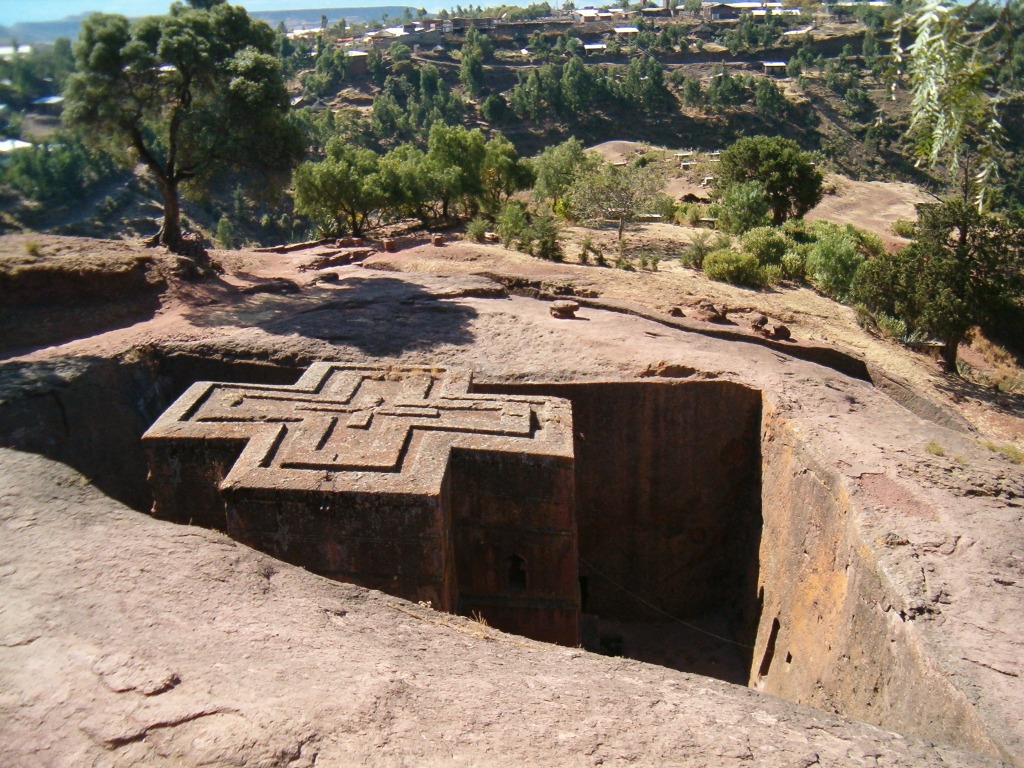
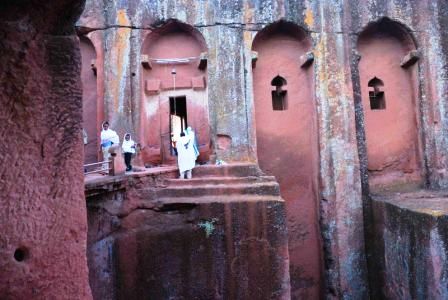
Chthonic churches at Lalibela


Lalibela is a town in northern Ethiopia that is famous for its monolithic rock-cutchurches. This rural town is known around the world for its churches carved from the living rock, which play an important part in the history of rock-cut architecture. Though the dating of the churches is not well established, most are thought to have been built during the reign of Lalibela, namely during the 12th and 13th centuries.


Thanks to 2nd year critic Quynh Vantu for bringing up this reference during Monday's crit.

Saturday, March 8, 2014

'Material Imagination' Lecture by Dean David Dernie March 12th 6PM


"As we move towards a digital age of building, where we design, model, procure and even build digitally, architecture is inevitably propelled into a virtual realm. At the same time, we all know that the material conditions of our environment still matter and this lecture will argue that the architecture is first and foremost a physical thing: an architect’s palette comprises of material forms and light. In foregrounding shape and surface, design software promotes a technical (or otherwise fragmentary) knowledge of material."

When: Wednesday 12 March at 6pm
Where: Fyvie Hall, 309 Regent Street, London W1B 2UW


Find out more and book your place

Wednesday, January 8, 2014

NOMADS Exhibition at Riflemaker


"Graham Fink’s debut exhibition NOMADS consists of twelve of the most insistent ‘pareidolia’, printed onto the purest white marble. The medium radiates life through the layers amalgamated in the printing process, one of the oldest known to man. The spirits take on another existence, becoming at one with the stone. As with the aeolian harp, the music in the air, they are always waiting. All we have to do is look."

NOMADS is at 

Riflemaker 79 BEAK STREET REGENT STREET LONDON W1F 9SU www.riflemaker.org 
9th – 22nd January 2014 Private view Wednesday 8th January 2014

Shown above: Green Rembrant Photography printed onto white marble from the quarries of Thassos
60 cm x 45cm x 1cm 2012

from FAD.

'Out of Ice' at P3 17 January - 9 February 2014

ElIZABETH OGILVIE
OUT OF ICE

17 January - 9 February 2014

Out of Ice portrays the psychological, physical and poetic dimensions of ice and water in a vast immersive installation in the subterranean spaces of Ambika P3, created by Scottish environmental artist Elizabeth Ogilvie.

Fusing art, architecture and science in an experiential artwork comprising ice, water, video projections and film, Out of Ice is a portal to the hidden extremes of our planet.

Visitor Information:
Ambika P3, University of Westminster,
35 Marylebone Road, London NW1 5LS
Baker Street Station
Daily except Mondays
Tue – Fri, 11am – 7pm
Sat – Sun, 12pm – 6pm
Admission: Free
Information: 020 7911 5876

www.p3exhibitions.com

Thursday, January 2, 2014

Arata Isozaki and Yoko Ono at Snow Show


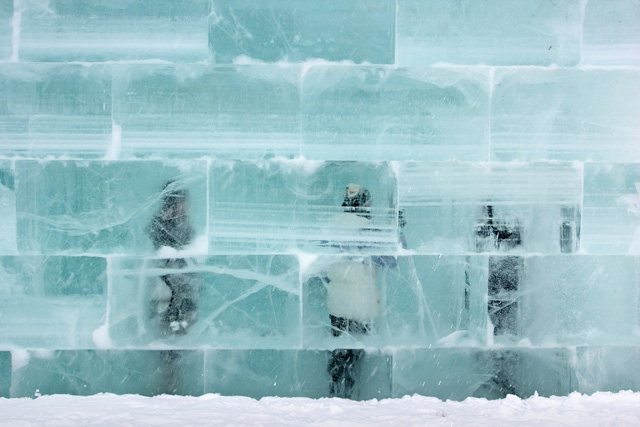
"The Snow Show is an ephemeral construction festival intending to create a bridge between the world of contemporary art and architecture. 17 works have been constructed since 2000, when the Art Show was originally conceived by curator Lance Fung.

In 2004, a partnership was established by Yoko Ono and Arata Isozaki, and a work was conceived and built using ephemeral materials such as snow and ice.

Their pavillion used harvested ice from a frozen lake in the Sestriere. The blocks came from a lower layer of the lake, where the ice is blueish or turquoise depending on the minerals contained in the water. Once cut with a chainsaw, each block, measuring 1 metre in length by 0.6 metres in height by 0.6 metres in width was lifted by a logging crane and transported to the site.
The blocks were then positioned in order to fit together. Once each block was put into place, water was poured to fuse the ice together. Finally the material was finished using setaline torch and smoothing the surfaces, giving a translucent tone to the construction."


From SOCKS.

Wednesday, December 18, 2013

Sean Griffiths on the American Bar in Vienna by Adolf Loos


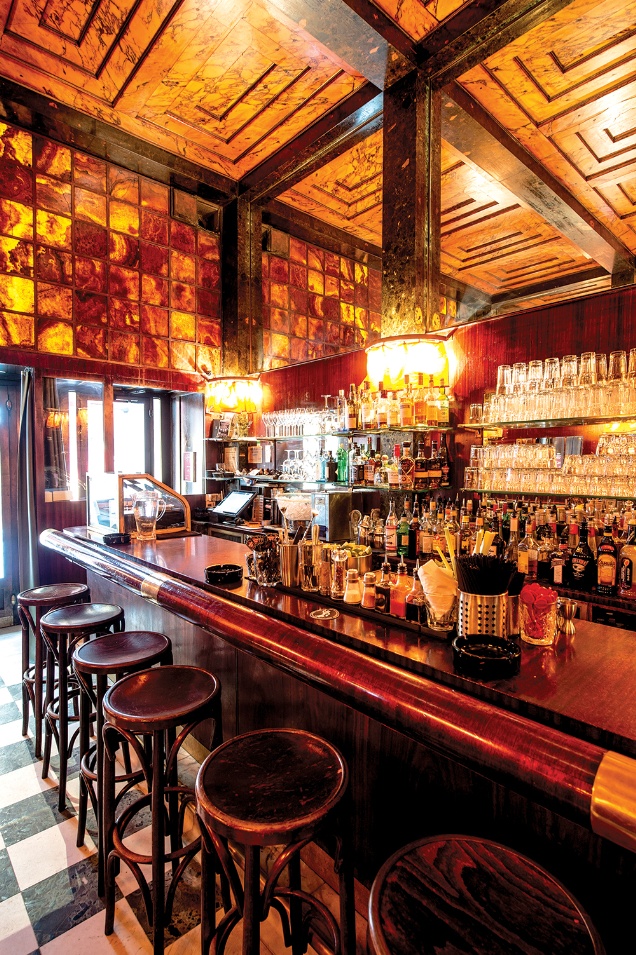
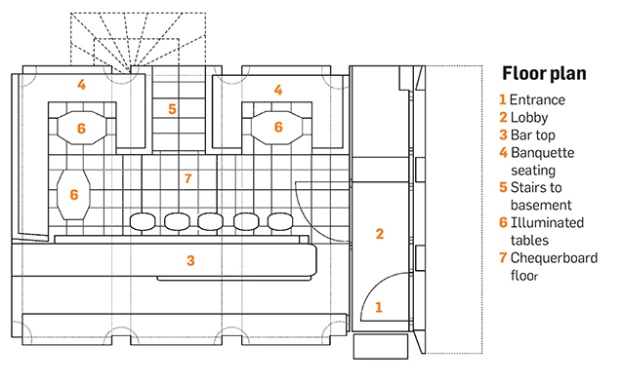
"The American Bar is an astonishing interior.

As well as being a very radical piece of early 20th century design, as Europe’s first ever cocktail bar (cocktails are an American invention) it brought a decadent New World experience to an old imperial Europe on the verge of catastrophic dissolution."

More from Sean Griffiths at BD.


Thanks to Níall McLaughlin for mentioning the article.

Tuesday, December 17, 2013

I-LANDS Installation


I-Lands is an interactive installation that incorporates sound, water, wax, and temperature to explore the chaotic and random individual influences constantly present in climate and landscape formations. Composed and generated by individual visitors that engage with strategically placed 'activators', it is a generator of topographies.  The work acknowledges that individual actions can generate unpredictable processes.


Part of Ines Dantas's *Emospheric Arch-I-pelagos series, it was performed in June 2012 at the Institute for Experimental Architecture, in Innsbruck, Austria.