
Showing posts with label renovation. Show all posts
Showing posts with label renovation. Show all posts
Monday, November 28, 2016

Tuesday, September 22, 2015
New book: Refurbishment ('best of DETAIL' series)

"...the amount of work to be done on existing buildings is steadily increasing. This is partially a reflection of the advancing age of buildings, but it is also due to constant changes in building and social requirements.
The desired or necessary measures, however, are always personalised and vary considerably. As a result, there is no standardised or widely understood term that can be used to describe the range of construction activities related to existing buildings. Reflecting this, "best of DETAIL Refurbishment" presents a comprehensive range of highlights from DETAIL on the topics of renovation, extension, restoration, refurbishment and conversion.
In addition to specialised theoretical contributions, the publication features an extensive section with examples of projects. From small-scale measures to the supersized category, it offers abundant inspiration as well as a variety of approaches to solving problems."
browse through selected pages here.
order from DETAIL.
Saturday, April 25, 2015
Tokyo Bar by Kengo Kuma
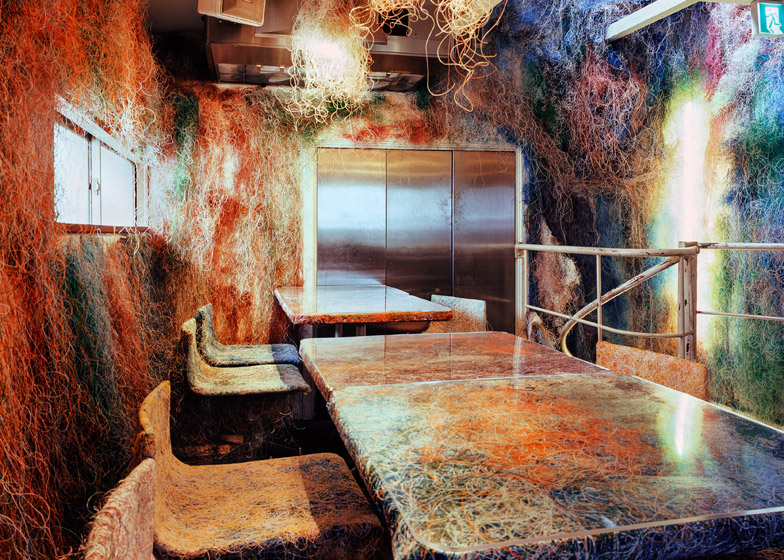
"Tufts of brightly coloured electrical cabling give the walls and furniture of this bar by Japanese architect Kengo Kuma a hairy appearance. The tangle of rainbow-hued wires drapes down the walls, over table-tops and chair backs, and around light-fittings in Tetchan – a bar that serves grilled meat skewers known as Yakitori."
more at dezeen.
Tuesday, September 30, 2014
ReMIX outlines house renovation plans with UV installation
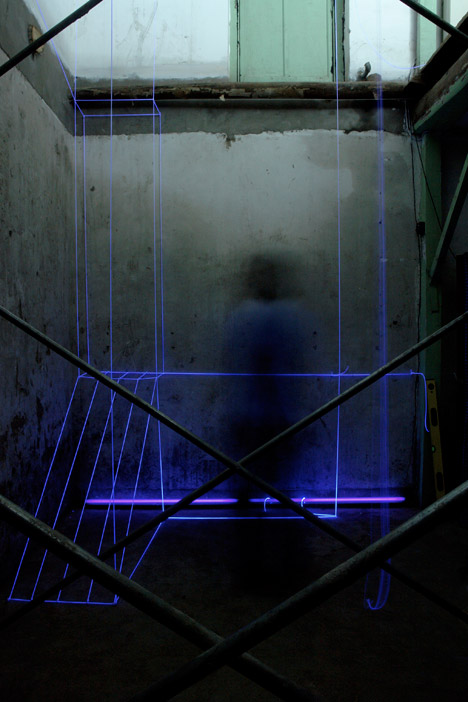
"Beijing architecture firm reMIX Studio has literally outlined its plans for the renovation of an ancient hutong residence by marking proposed structures with illuminated white strings
ReMIX is in the process of overhauling the interior of an old building in the Dashilar hutong, where a lot of regeneration work is being undertaken.
However, the architects knew early on the project would not be completed to show visitors to the area during the city's annual design week, so came up with an alternative presentation.
"We came up with a way to visualise our plans instead," reMIX cofounder Federico Ruberto told Dezeen."
more at Dezeen,
Sunday, November 17, 2013
Carlo Scarpa Documentary
Carlo Scarpa (June 2, 1906 – November 28, 1978), was an Italian architect.
Scarpa refused to sit the pro forma professional exam administrated by the Italian Government after World War II. As a consequence, he was not permitted to practice architecture without associating with an architect. Hence, those who worked with him, his clients, associates, craftspersons, called him "Professor", rather than "architect".
His architecture is deeply sensitive to the changes of time, from seasons to history, rooted in a sensuous material imagination.
Scarpa refused to sit the pro forma professional exam administrated by the Italian Government after World War II. As a consequence, he was not permitted to practice architecture without associating with an architect. Hence, those who worked with him, his clients, associates, craftspersons, called him "Professor", rather than "architect".
His architecture is deeply sensitive to the changes of time, from seasons to history, rooted in a sensuous material imagination.
Tuesday, October 1, 2013
Happy Magic Water Cube waterpark in Beijing
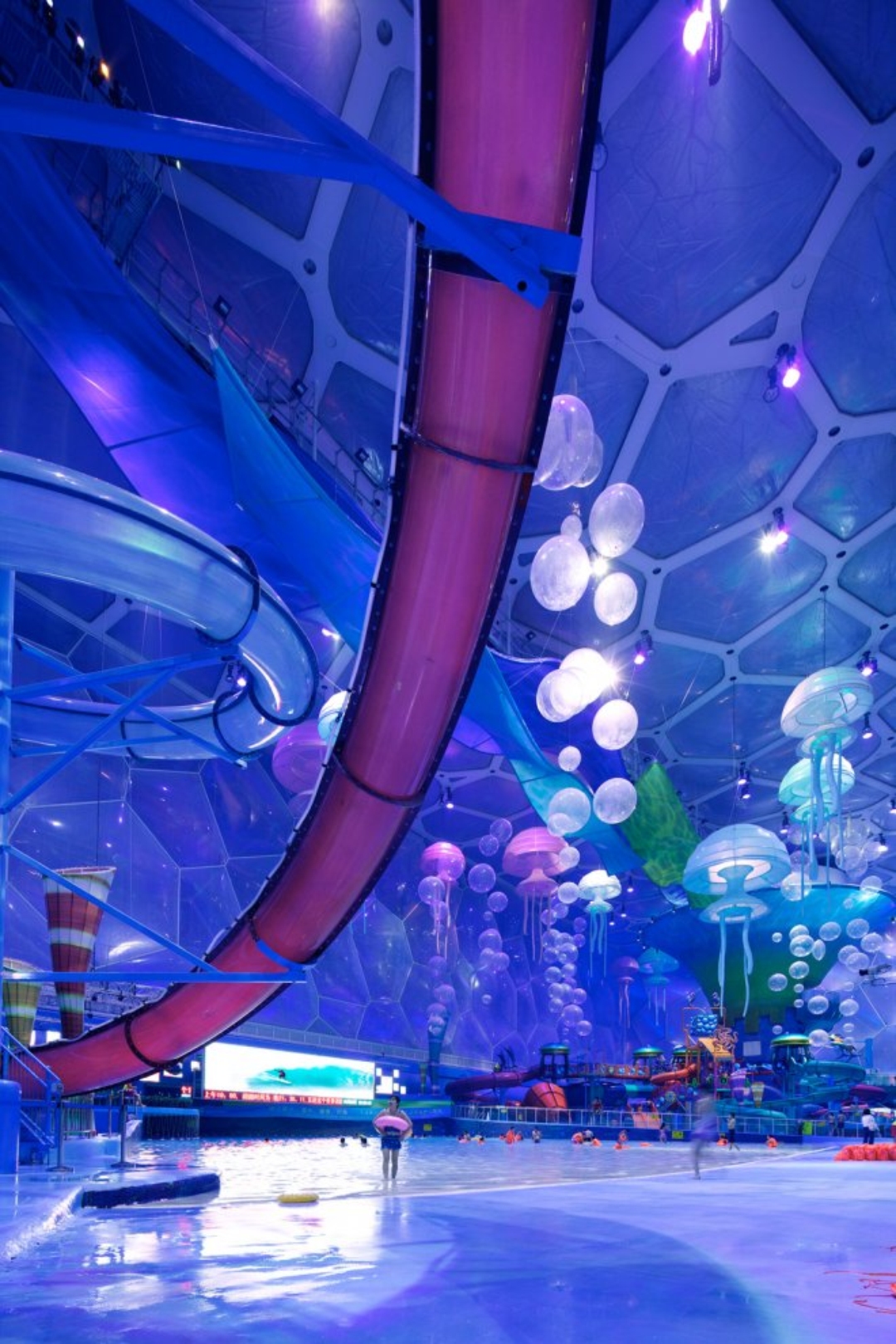
"Since its opening last year, Happy Magic Water Cube waterpark (the best name for anything, ever?) has become Beijing's second most popular destination, enticing visitors with a lazy river, wave pool, and speed slides, among other attractions. Blatant representations of underwater life in the form of inflatable jellyfish and seaweed irreverently brush up against the more austere (read: "serious") architecture. It turns out that the much celebrated ETFE membrane is the ideal backdrop for the playful proceedings, providing plenty of daylight by day, and turning the perfect shade of ocean blue at night.
There may be some naysayers who protest at the "debasement" of an architectural landmark. But there are many more who question the motives and decisions behind the making of Olympic-scale projects. No one pays more for these projects than citizens of the host city, who not only fork over tax dollars, but also powerlessly forfeit tracts of their metropolis in the name of "urban renewal". Olympic stadiums never make good on their investments, so why do city planning boards continue to eagerly sign off on the whims of a starchitect? It's time to say "no" to the Pritzker laureates and "yes" to more waterparks."
from architizer.
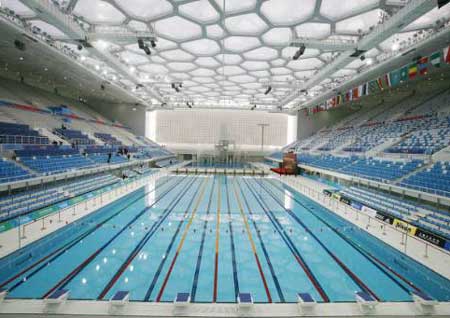
(the host building in its first incarnation.)
Friday, March 22, 2013
Refurbishment of Deusto University by ACXT

More at archdaily.
Tuesday, February 5, 2013
'Bastard Store' by studiometrico


 #
#From archdaily: "Italian practice studiometrico shared with us how they converted an old cinema in Milan, into the new Bastard flagship store, which also includes a suspended bowl and offices for Comvert."
more here.
Tuesday, January 29, 2013

Sunday, December 2, 2012
School of American Ballet by Diller Scofidio + Renfro


At first blush, it seems that the architect and the dancer have little in common. Dealing with structures and edifices, architects strive for permanence of form; dancers work with gestures and movements, resulting in fleeting moments of beauty. But when architect Elizabeth Diller began redesigning the School of American Ballet (SAB), in collaboration with its artistic director, Peter Martins, she was struck by the affinities between the two disciplines. “We kind of do the same thing,” she says. “We’re interested in bodies and space, and we’re interested in overcoming laws of gravity.”
A couple of years ago, Martins decided he wanted to halve one of SAB’s more spacious studios. Having another one running would mean more classes, more students, and more flexibility for his pupils, most of whom study dance part-time in addition to taking a full load of academic classes. The fifth-floor space of the Samuel B. and David Rose Building at Lincoln Center was double-height, so Martins hoped to divide it horizontally, stacking the volumes “like pancakes.”
Before Diller took on the job, the architecture firm Davis Brody Bond suggested dividing the space with a conventional floor. Unfortunately that would have blocked the natural light from the windows, leaving the upper studio dark and cramped. Hoping for a more creative solution, Martins and his colleague Marjorie Van Dercook, executive director of SAB, approached Diller Scofidio + Renfro, which was already overseeing an ambitious $700 million renovation of Lincoln Center. About five minutes after Diller saw the space, she told Martins that it was certainly possible to stack a studio on top of another in a way that allowed for plenty of room and light. “You could suspend it,” she told him. “It would float.” Martins and Van Dercook were so enthusiastic that they asked Diller to draw up plans for a similar space next door. Eight months and $7.2 million later, there were two split-level studios separated by a lounge where donors and parents can observe classes.
From Metropolis Magazine 'Bodies and Spaces' by By Belinda Lanks
Saturday, March 17, 2012
Wyckoff Exchange by Andre Kikoski Architect

Manhattan firm Andre Kikosi Architect installed a folding Corten steel façade to transform this disused New York warehouse into a market and music venue. The motorised façade of The Wyckoff Exchange is made up of five panels, which fold outwards to shelter the pavement and reveal a glass skin beneath. LED lights hidden within perforations on the metal sheets give the building a glowing effect at night, when the shutters provide protection for the shops inside. The building houses a live music and performance venue, an organic food market and boutique wine shop.


Saturday, December 3, 2011
From factory to Kunsthall:Petra Gipp Arkitektur

"In the landmarked industrial building, dating from the last turn of century, there are imprints of different eras. It can be compared to an archive – layers of time. The building has served as ammunition factory, paint factory and presently as kunsthalle for contemporary art and architecture.


The visitor is lead through a narrow alley with the light from above shining down towards the water. The walkway runs close to the kunsthalle as it passes the entire building, to then be invited into the dark stairway and the vast pillar hall."
Ground floor, first and second floor plans, along with further description and images can be found at archdaily.
Sunday, November 27, 2011
Garden Museum: Dow Jones Architects
from archdaily:
In October 2007, Dow Jones Architects won an architectural competition to redesign the museum. The competition brief asked for a new gallery space where temporary exhibitions could be housed in secure and environmentally-controlled conditions.

The designers say:


In October 2007, Dow Jones Architects won an architectural competition to redesign the museum. The competition brief asked for a new gallery space where temporary exhibitions could be housed in secure and environmentally-controlled conditions.

The designers say:
"It appeared to us that creating a dedicated place for the museum’s permanent collection was equally important, as the exhibits were frequently moved to make space for events. We developed a strategy which addressed both issues.
Our idea was to create a belvedere within the existing building. This houses the new galleries and provides a raised ground from which a new perspective of the existing building is attained.


The belvedere structure enables us to place the temporary gallery at ground floor level and move the permanent collection, from its former location in the nave, up to the new first floor level."
This museum is about a five minute walk from Beaconsfield.
Subscribe to:
Comments (Atom)