
Showing posts with label sustainable design. Show all posts
Showing posts with label sustainable design. Show all posts
Wednesday, February 8, 2017

Monday, October 17, 2016
Enric Ruiz-Geli (Cloud 9) Lecture 20th October

Enric Ruiz-Geli (Cloud 9)
Media ICT and El Bulli
Thursday 20th October, 6pm
Robin Evans Room (M416)
University of Westminster
Department of Architecture
Enric Ruiz-Geli is an architect based in Barcelona who works with a group of collaborators and researcher’s as Cloud 9. Enric works at the interface between architecture and art, digital processes and technological material development. The architects’ multifaceted projects include stage designs and buildings, installations and technical patents. In 2011 he was awarded the prize for best building by the World Architecture Festival (WAF) for his groundbreaking net zero-energy building project ‘Media-ICT’ in Barcelona, which featured bioluminescent fireproof paint and an interactive smoke filled ETFE wall.
Key projects of Enric Ruiz Geli / Cloud 9 include the Villa Nurbs in Empuriabrava, an organically formed, ecological and futuristic house; Media-ICT building in Barcelona and the elBulliFoundation for the chef Ferran Adrià. Designed as a living laboratory in Cap de Creus on the Spanish/French border, the elBulliFoundation (culinary institute) is designed to sustainably regenerate its site within a national park using a mixture of ancient and contemporary environmental design strategies and is being developed in partnership with the national parks authority.
For details contact Will McLean - w.f.mclean@westminster.ac.uk
Technical Studies website - www.technicalstudies.tumblr.com
Friday, December 11, 2015
Aerocene metallic orbs by Tomás Saraceno in Paris' Grand Palais

"By releasing hot air from inside the Aerocene globes, pressure can be regulated and the altitude of the orbs can be controlled. They could also float along natural jet streams, using these as a way of changing direction."
from dezeen.
Friday, October 23, 2015
Michael Sorkin Inaugural Lecture at University of Westminster: 26 November

Competition for Wuhan Qingtan Lake Ecological Park Urban Design Competition 2014, First Place.
VISITING PROFESSOR, DEPARTMENT OF ARCHITECTURE
INAUGURAL LECTURE
26 November 2015, 18.30 – 20.00
University of Westminster
Room MG14
25 Marylebone Road
London NW1 5LS
City States
In his inaugural lecture as a Visiting Professor in the Department of Architecture at the University of Westminster, Michael Sorkin will speak about the relationship between equity and sustainability in cities and advocate for a radical assumption of responsibility by cities. He will argue for the necessity of creating both new kinds of urban relations as well as new kinds of cities. The talk will be illustrated by a series of examples of work by the Michael Sorkin Studio and Terreform.
Michael Sorkin is an architect and urbanist whose practice spans design, criticism, and teaching. He is the principal of Michael Sorkin Studio in New York, a global design practice focused on urbanism and green architecture, and Terreform, an independent urban research and advocacy centre whose mission is to investigate the forms, policies, technologies, and practices that will yield equitable, sustainable, and beautiful cities for our urbanizing planet
Wednesday, March 19, 2014
David Rockwell's temporary bespoke theater for TED 2014
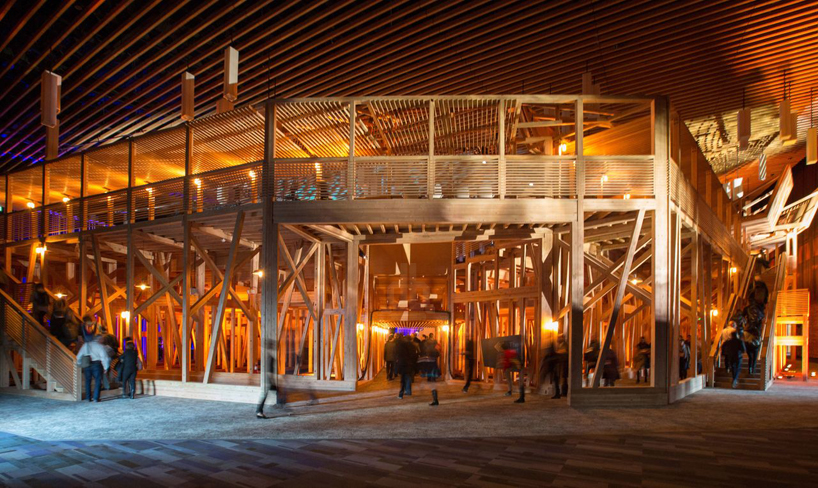
"TED, the nonprofit enthusiastic to ‘ideas worth spreading’, has invited the rockwell group to build the stage for the 30th anniversary of the conference, in vancouver. set in the vancouver convention centre, the portable and temporary theater is constructed with 600 pieces and assembled onsite for the five day festival. the intimacy of the space is realized by instilling a sense of community while having singularity in form. the individual and the collective are showcased in unison as the arena becomes a manifestation of the organization’s core principles. in addition to david rockwell’s observations, from being an attendee over the years, further inspiration for the theater was gathered from historic organizational spaces such as campfires and other non permanent commons. comprised mostly from locally harvested douglas fir wood sourced from the pacific northwest, the seating ‘bowl’ also includes a walkway along the perimeter with lattice-like platforms and handrails. 16 different seating options are present, and vary from lounge groupings, rows of benches, and beanbags. a standing room area in the back allows viewers to access personal electronic devices, without disturbing the rest of the audience. aided by an electronic cutting machine, the event construction company, nussli, fashioned the structure (along with the custom furniture and steelcase fabrication) to be easily disassembled back into 8’ x 10’ x 12’ boxes, and possibly reused for upcoming events."
from designboom
Friday, December 20, 2013
Françoise Bollack's 5 Adaptive Reuse Strategies

In her book Old Buildings, New Forms, Françoise Bollack divides adaptive reuse projects into five categories, and illustrates each with a diagram (from left to right): wraps, weavings, juxtapositions, parasites, and insertions.

Insertion for instance, is exemplified by a 2004 project by FNP Architekten. A crane dropped a new shell of weather-resistant plywood inside a 200-year-old abandoned pigsty in Rheinland-Pfalz, Germany. The “house within a house” is now used as an occasional showroom and meeting place.
To see examples of the other strategies see the article in ARCHITECT.
Or buy the book.
Image Credits: Monacelli Press
Saturday, September 14, 2013
'Second Nature'
Second Nature is a 20-minute documentary on skater and budding landscape architect, Janne Saario of Finland. The short film allows a glimpse of Saario’s thoughts and dreams, which float between design, art and skateboarding. Though it also reveals the important concurrence of post-industrial areas, sustainable concepts and natural environments, and unfolds the demanding obligation, towards today’s generation and those to come, to create positive and inspiring, local communities.
Thursday, June 6, 2013
King's Cross Filling Station by Carmody and Groarke
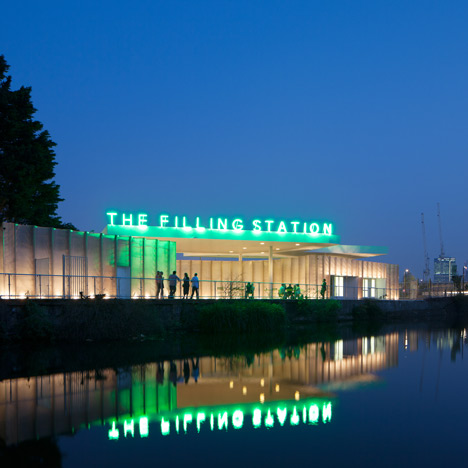
More at dezeen.
Friday, April 19, 2013
Elena Garro Cultural Center by Fernanda Canales + arquitectura 911sc


more at archdaily.
Friday, March 22, 2013
Refurbishment of Deusto University by ACXT

More at archdaily.
Tuesday, January 15, 2013
New Issue of a + t: RECLAIM
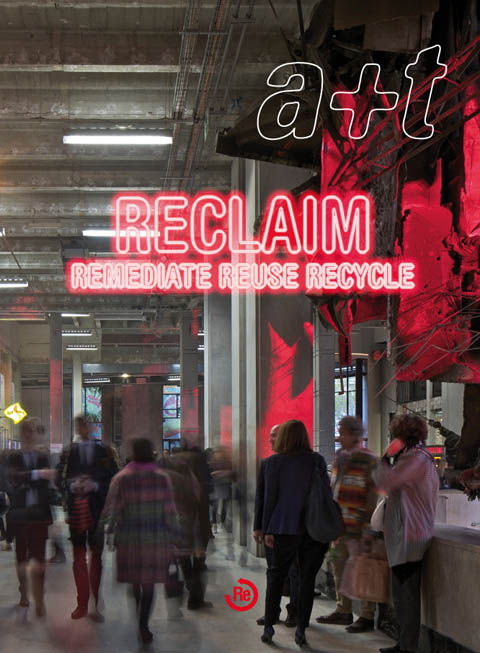
It publishes a+t magazine - whose issues are edited in thematic series - and books on collective housing and public space. With this start to the Reclaim series, a+t interprets the works analysed and organizes its discourse on the basis of Re- actions, using these actions to create a body of knowledge applicable to any project.
Reclaim has the environmental sense to reclaim the territory, the objects, the infrastructures and the materials yet it also is a call to reclaim dignity and citizen rights. It is a wake-up call to morally reclaim society using theRe- processes as atonement.
Remediate Reuse Recycle interprets and compares actions extracted from the projects and classifies them into three Re-processes:
Reuse: acting on the building
Recycle: acting on the material
more info at a+t
Sunday, November 25, 2012
God’s Loftstory / LKSVDD

© Vincent van den Hoven

© Vincent van den Hoven
It was a conscious choice, not to fill the volume of 1100 m3 completely with as many rooms as possible, but to minimize the demands, in order to retain the spaciousness of the building. The only architectural additions are the mezzanine for the relaxation room ( couch, bed and bath ) and the multifunctional “Stairway to have fun” ( stairs, room divider, closet, build-in-kitchen, acoustic element and exhibition wall ).
from archdaily.
Wednesday, October 17, 2012

Wednesday, September 26, 2012
Cassia Coop Training Centre by TYIN Tegnestue Architects

Located in Sungai Penuh, Kerinchi, Sumatra, Indonesia, the main idea behind the project is the classic consept of a light wooden construction on a base of heavy brick and concrete. The wooden construction gives a feeling of being within a cinnamon forest. Cassia Coop Training Centre is built around a pair of mighty durian trees, with a scenic view of the beautiful Kerinci-lake in the front and with its back towards lush cinnamon forest. A major challenge has been to create a naturally ventilated climate beneath a roof surface of no less than 600 square meters. Knowledge and experience gained in former projects have greatly aided us in achieving this, through the use of thermal mass, reduction of sunrays and maximized eaves.


Subscribe to:
Comments (Atom)