Friday, November 9, 2012

HEINER GOEBBELS: STIFTER’S DINGE RETURNS TO AMBIKA P3


Photograph by Nick Cobbing for Artangel
The 2008 Artangel project Stifter’s Dinge, by German composer and director Heiner Goebbels, is inspired by the 19th century poet and painter Adalbery Stifter and uses mechanical objects, music, projections and natural elements to create a composition in the form of an installation, written for five pianos with no pianists.
This year it returns for the final time to its original home at Ambika P3, a vast concrete construction hall on Marylebone Road. As well as reviving the 2008 seated performance, a new site-specific version has been created to renew the composition; Stifter’s Dinge: The Unguided Tour allows visitors to freely explore the environment, experiencing the work as a continuously developing installation.

Stifter’s Dinge is at Ambika P3 4th-18th November 2012. 
text from la scatola gallery.

Wednesday, November 7, 2012

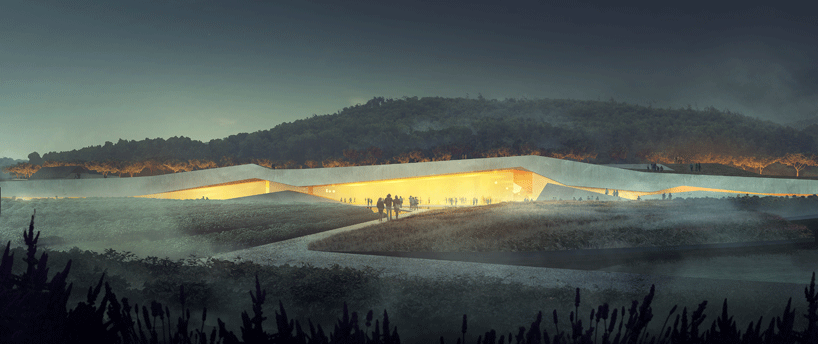
snøhetta: lascaux caves visitor center


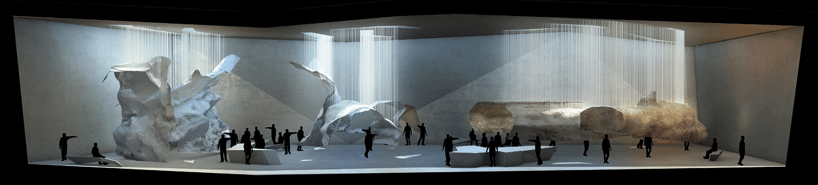
norwegian practice snøhetta has recently been awarded the bid to design the new 'lascaux caves visitor center' on the boundary of the vezere valley and the hillside, between a dense forest and man-formed agricultural land in motignac france. the project will display the artwork created by prehistoric artists on the walls of the natural stone vaults, and just like these artists who took cues from the existing textures and irregularities to communicate their ideas, so does the architecture exist within a small fissure following the contours of the landscape to effectively expose the subtle intricacies of the site. the long glass facade faces north towards the city of montignac to receive visitors. varying transparencies define the curtain wall facade that constantly maintains a profile with the immediate environment. the public service spaces are located towards this glass wall, receiving plenty of natural light, while the exhibitions are discovered as the visitor explores further into the earth through a similar path that the ancient inhabitants used in order to reach the same point. the project presents itself through a series of majestic spaces filled with silence, bustling trees, penetrating light in vast dark spaces, hard rock surfaces and lively vegetative components that restore the spirit of the caves and their treasured paintings.

Friday, November 2, 2012

Tomas Saraceno


Artist Tomás Saraceno follows the tradition of those who have looked up to the sky to envision works of uncommon optimism that explore systems of interdependencies, both inside and beyond the natural world. 


Kengo Kuma - 'Power of Place' Lecture. Wednesday 7 November 2012


19:00 Wednesday 7 November 2012
Kengo Kuma - Power of Place
Bartlett School of Architecture International Lecture Series

Lecture: Christopher Ingold Auditorium, UCL Chemistry Building, 20 Gordon Street, London, WC1H 0AJ

The renowned Japanese architect has been featured on this blog  several times:

Wednesday, October 24, 2012

'Borderline' Installation


as part of 2010's international architecture biennale in venice, italy, the hungary pavilion 

explored the simplest and most fundamental act of the architect: drawing. 'borderline
defines the line as the origin of the architectural idea as opposed to the house or space. 
using the almost exclusively two-dimensional element as a focal point, the project utilized 
nearly one hundred kilometres of thread to physically illustrate how lines are translated 
into architecture. 

image © tamás bujnovszky


more at designboom

Thursday, October 18, 2012

Jonas Dahlberg


Jonas Dahlberg is one of Sweden’s most prominent artists, working at the intersection of art, architecture and film.
http://www.jonasdahlberg.com


School Corridor, 1986
2010. Kinetic sculpture. Aluminium, steel, LED lamps, motor. Dimensions 135 x ø92.5cm


This work is something between a sculpture and a mechanical film. I’ve constructed a series of small, three-dimensional “film frames” creating a horizontal wheel, recalling a film reel. When the wheel rotates, the rooms are fed forward like a film in a projector, creating an animation. The rooms are constructed with imperfections and scratches so that the feeling of early animation mechanisms and early cinema comes to mind.

In the work I’m addressing an idea of how memories and film-animations have a connection to each other by the way they are similarly constructed. To be able to create an animation and an illuminated frame—or in this case a room—it’s necessary to always have a dark interval before the next frame/room. The illuminated image is then imprinted on the retina and is linked by the eye's memory to the ensuing room, creating a continued movement.


An Imagined City  (work in progress)

This October, Dahlberg will present a site-specific work on and around the old post office in Stockholm. The piece is an architectural sound and light installation produced by MAP, Mobile Art Production. During the restoration of the old post office on Nybrogatan 57, Jonas Dahlberg has transformed the building into an austere, black façade to use as his backdrop. In daylight, the temporarily blackened building becomes the archetypal image of contemporary architecture, only to be transformed into a seemingly black hole at night. When darkness falls, four windows light up and shine their spotlights down onto the street. The beams are filled with voices that take the viewer on a journey through cities, places and buildings, in stories that are based on an archive of memories of cinematic rooms and spaces. The austere façade, or the black hole, becomes a screen onto which the audience can project their own memories, thoughts and ideas regarding architecture and what a city could be.

Since the very beginning of his career, Jonas Dahlberg has worked with staged situations revolving around the viewer’s movements through spaces in different fictitious worlds. In An Imagined City, he deepens his interest in the mirroring of psychological architecture. To date, Dahlberg’s preferred medium has been film, but in An Imagined City, he leaves the medium behind and steps straight onto the street, where the viewer becomes the focus of events.

An Imagined City is a temporary staging of public space, a kind of theatre where everything is possible. What kind of city do we want? Which architecture is imaginable in the first place, and what happens when one temporarily dramatises a quotidian milieu?

Sunday, October 14, 2012

Tatzu Nishi – “Discovering Columbus” In New York City

Interior View of Installation
The new project by Tatzu Nishi, mentioned recently on the blog in this post, is a faux living room around the iconic statue of Christopher Columbus that is situated in the middle of Columbus Circle in Manhattan.

Exterior View of Installation

View of Columbus Circle without installation


Saturday, October 6, 2012

Nendo Mimicry Chairs, London Design Festival 2012


This year as part of London Design Festival’s Landmark Projects Japanese design studioNendo have installed Mimicry Chairs, a series of sporadically placed chairs, in the Victoria and Albert Museum. Rising stars of Japanese design,  have already exhibited in Madrid, Milan, Paris, Tokyo and New York. 

More about Nendo here.

Thursday, October 4, 2012

Maya Lin Lecture at the Tate Modern: Monday 15 October 2012


American Artist Lecture Series: Maya Lin

Tate Modern, Starr Auditorium
Monday 15 October 2012, 18.30 – 20.00
student tickets £9

Maya Lin
2 x 4 Landscape 2006
Maya Lin has maintained a careful balance between art and architecture throughout her career, creating a remarkable body of work that encompasses large-scale site specific installations, intimate studio artworks, architectural works and memorials. She draws inspiration from the landscape, interpreting the world through a twenty-first century lens, merging rational order with notions of beauty and the transcendental. Her work asks the viewer to reconsider nature and the environment at a time when it is crucial to do so.
More info and booking here.

Wednesday, September 26, 2012

Cassia Coop Training Centre by TYIN Tegnestue Architects


Located in Sungai Penuh, Kerinchi, Sumatra, Indonesia, the main idea behind the project is the classic consept of a light wooden construction on a base of heavy brick and concrete. The wooden construction gives a feeling of being within a cinnamon forest. Cassia Coop Training Centre is built around a pair of mighty durian trees, with a scenic view of the beautiful Kerinci-lake in the front and with its back towards lush cinnamon forest. A major challenge has been to create a naturally ventilated climate beneath a roof surface of no less than 600 square meters. Knowledge and experience gained in former projects have greatly aided us in achieving this, through the use of thermal mass, reduction of sunrays and maximized eaves.


from archdaily.