Sunday, October 19, 2014

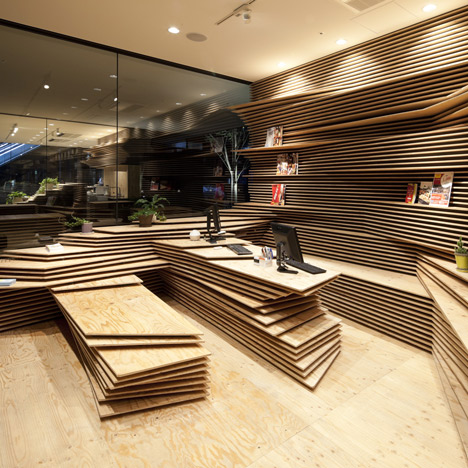
Gurunavi cafe and info centre by Kengo Kuma


Kengo Kuma designed the interiors of two spaces for Gurunavi: one that's used as a physical base and information centre for the Japanese restaurant guide and another that serves as a cafe. He layered wooden boards to create striations inside this workspace and cafe for an online restaurant guide based in Osaka Japan.

from dezeen.

Thursday, October 16, 2014

"Lessons for Students in Architecture" by Herman Hertzberger


"Rather than supplying the reader with design recipes... Hertzberger has provided an essential source of inspiration.  In his view everyone - the more he sees, experiences, and absorbs - is automatically in possession of an ever-expanding arsenal of potential instructions with which to choose a path towards a result."

more here.

'Shooting Thoughts' by Filipe Vilas-Boas


"This past week, experience designer Filipe Vilas-Boas launched his latest public project, Shooting Thoughts, in the stunning French Gothic church of Saint-Eustache, Paris. Co-commissioned by Art, Culture et Foi and Nuit Blanche Paris, Shooting Thoughts is an interactive installation project that uses projection mapping to create a “constellation of stars.”

Shooting Thoughts  uses "text messaged thoughts" to create catalysts "for laser beams that travel up the pathways defined by the building's architecture. The project description explains,“The pillars are used as launch stations that carry the star to its final destination on the ceiling of the church via the arches and vaults. Like all of us, each star finds its place at its own speed with its individual trajectory.”

Wednesday, October 15, 2014

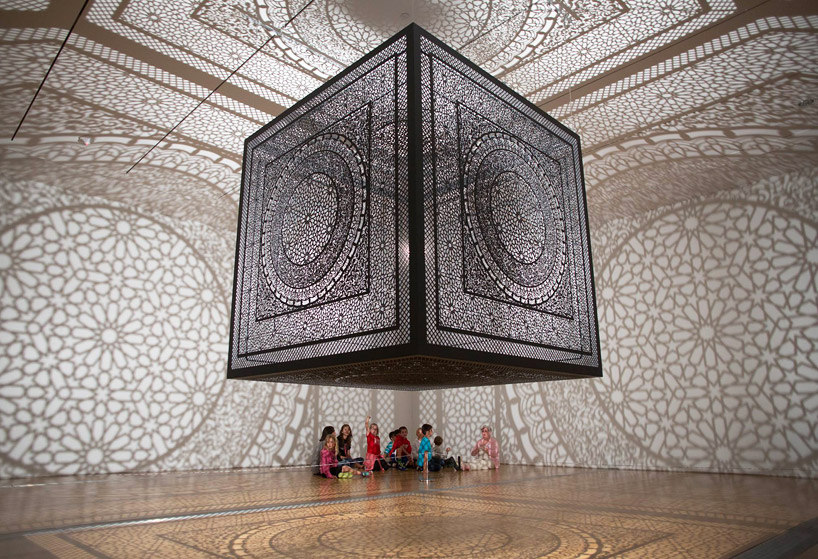
"Intersections" by Anila Quayyum Agha


"anila quayyum agha casts a delicate web of shadows with a single light bulb

pakistani artist anila quayyum agha exercises the architecture of the grand rapids art museum in michigan by infilling it with a dynamic interplay of shadow and light.‘intersections’ comprises a 6.5-foot laser-cut wooden cube pierced with carefully crafted patterns and illuminated from the inside, which casts expansive, lace-like geometries onto the surrounding walls, ceiling and floor."

from designboom.
image courtesy of sarah’s throne

Monday, October 13, 2014

Uppe Folly for King's College London by Mobile Studio

Uppe Folly for King's College London
Arts & Humanities Festival 2014 | #AHFest

Dates: 15th - 24th Oct 2014 (9am-8pm)
Free, open to all during campus opening hours. Booking not required.
Add: King's College London, Strand, London WC2R 2LS (map)

Mobile Studio Architects designed a pop-up modular folly for KCL Arts & Humanities Festival 2014 (#AHFest). Uppe Folly is located in The Strand Quadrangle, a long and relatively narrow space confined by the tall façades of KCL and Somerset House. In response to the 'Underground' theme, Uppe Folly encourages visitors to simply stop and look up - something we often forget to do in a dense and busy city such as London.

Sunday, October 12, 2014

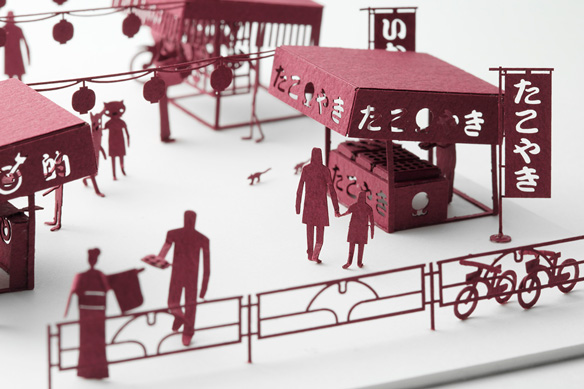
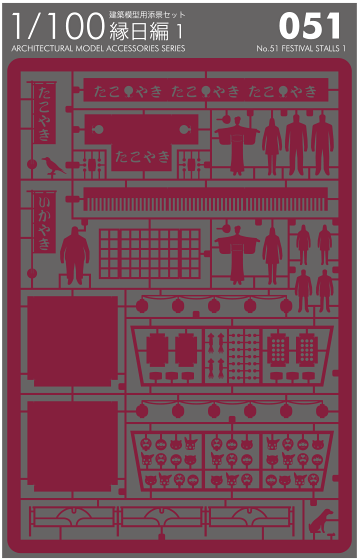
Scale figures and "Accessories series" by Terada Mokei


Scale figures made by designer Naoki Terada to 'make life easier at the office' have evolved into a product that includes "Accessories series" and are sold to the general public by Japanese company Terada Mokei

Thanks to Ryoko Uyama for pointing them out.

Saturday, October 11, 2014

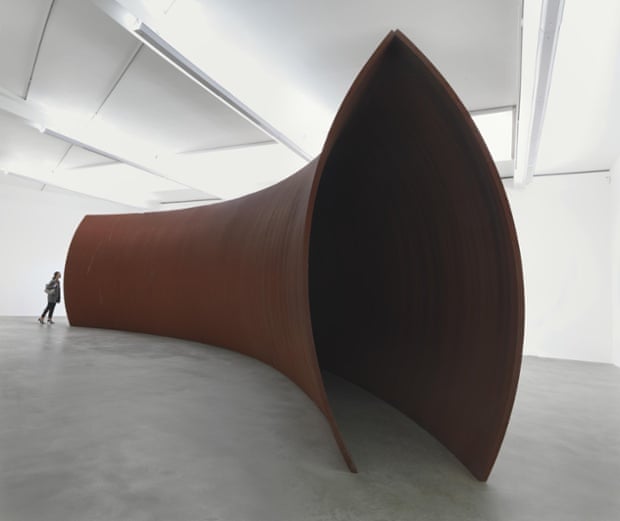
Richard Serra show at Gagosian Gallery, 11 Oct to 28 Feb 2015


"An ensemble of four very different works, with a room devoted to each, fills Gagosian in London, in Richard Serra’s first show of sculpture here since 2008. The sum is bigger than the parts, though each work is satisfying in its own way, and each is worth the trip alone. 'I wanted to make a show with different aspects of compression and circulation, intervals and elevation, different ways to approach a field or a space or a context,' the 74-year-old artist tells me, speaking from New York." (from the gaurdian)

Richard Serra is at Gagosian Gallery, London WC1, from 11 October to 28 February 2015.

Tuesday, October 7, 2014

Collages by Frank Dresme


"Project 360U+00B0 was a thesis project produced at The Utrecht School of Arts in 2007. The project, was vested in the production of four psychogeographic maps. These maps are the routes between personal destinations in Amsterdam."

more here.

Tuesday, September 30, 2014

CJ Lim lecture: 'Food Cities', 1 Oct 2014


CJ Lim
Food City: Lecture and Book Launch. 
01 Oct 2014
6.30pm – 8pm
No booking required / first come, first seated
Darwin Lecture Theatre
Map

Food City, the follow up to Smartcities and Eco-Warriors, explores the issue of urban and architectural transformation and how the creation, storage and distribution of food has been, and can again become, a construct for the practice of everyday life.

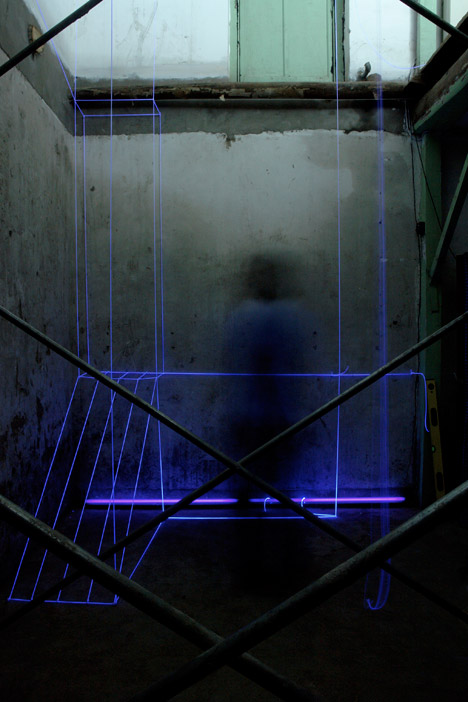
ReMIX outlines house renovation plans with UV installation


"Beijing architecture firm reMIX Studio has literally outlined its plans for the renovation of an ancient hutong residence by marking proposed structures with illuminated white strings

ReMIX is in the process of overhauling the interior of an old building in the Dashilar hutong, where a lot of regeneration work is being undertaken.

However, the architects knew early on the project would not be completed to show visitors to the area during the city's annual design week, so came up with an alternative presentation.

"We came up with a way to visualise our plans instead," reMIX cofounder Federico Ruberto told Dezeen."

more at Dezeen,

Friday, September 26, 2014

Philibert de l'Orme's "The bad and good architect", 1567


French architect Philibert de l'Orme was one of the great masters of the French Renaissance. In the final pages of his treatise Le premier tome de l’architecture of 1567 he featured two illustrations entitled "The bad and good architect."  The illustrations serve as a manifesto and communicate the ideals of their author.

"Whereas the bad architect wanders in a barren landscape dominated by a gloomy medieval castle, the good architect enjoys the pleasures of the garden.  Beautiful buildings rise on each side, their ornaments echoing the productions of nature.... Revealingly, in addition to lacking hands because he does not know how to make something useful, the bad architect has no recognisable features; he is deprived of eyes, nose, mouth and ears, whereas the good architect has a visage.  The latter is moreover, engaged in a dialogue with a young disiciple who turns his face towards him.  With their windows wide open like eyes surveying the scene, the nearby buildings seem to look on this conversation with benevolence."
-from Ornament: The Politics of Architecture and Subjectivity by Antoine Picon