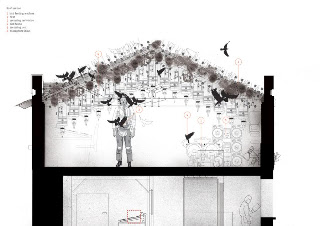
The University of Duesto decided to renew its Central Building, known as “La Literaria” (The Literary). The main objective of the architectural design was to respect and enhance the spatial, aesthetical and functional qualities of the original building.
More at archdaily.
A collection of sources, precedents, ideas, information, images, projects, and events to inspire and provoke University of Westminster Interior Architecture students.
Friday, March 22, 2013
Monday, March 18, 2013
"All Singing, All Dancing Drawings"
Saturday, March 9, 2013
The design genius of Charles + Ray Eames
From the TED blog.
Tuesday, February 19, 2013
CRISISASCALLING design competition
DESIGNCIRCUIT + REVERSE are pleased to announce:
CRISISASCALLING........a design competition
Registration + Submission Deadline: 4.22.2013
CrisisasCalling.........design competition
Crisis as Calling is an international design competition open to the public that invites participates to reconsider, and respond to the universal condition of Crisis.Crisis as an event implies a breakdown, and the collective response is typified by the attempt to return to "normal." We see this as more than an opportunity for responsive design; we see this as a calling for an expanded role for the design community, and we seek to explore uncharted courses to reveal innovative models for relevant engagement.
Call for Entries
Communicate a proposal that re-contextualizes the space for design to address the definition of crisis. The details of crisis typology and the boundaries for intervention are open, and should be clearly defined by each unique proposal.As crisis is a universal phenomenon with no bias or preferential destination, there are no restrictions to the type of project one may submit (specific location, program, or range).
For instance submissions might, challenge urban activism in times of trauma, the nature of informal building practices as emergency response, resource allocation as recovery stimulation, or community dynamics that enable awareness at larger scales. What should be clear in each proposal is how a particular challenge that is common to a clearly defined crisis set can be addressed as a materialized solution to a global predicament.
Competition Website: www.crisisascalling.com
Submission deadline: Monday, April 22, 2013
Friday, February 8, 2013
RDM Innovation Dock by Groosman Partners I Architecten
In the heart of the ports of Rotterdam, Groosman Partners Architecten used a crane track in a former machine hall to suspend 1000 m2 of office space. The hall is situated on the terrain of RDM (Rotterdam Dry-dock Company), a former shipyard recently rebuilt into a campus for education and innovation.
more at archdaily.
Wednesday, February 6, 2013
123D Update for Mac and PC
It's about time for an update
We've just released an update to 123D Make for Mac and Windows, including a new construction method, and multiple improvements for CNC users.
| ||||
What's new in 123D Make 1.1 for Mac and Windows:
| ||||
Unsubscribe | Privacy | Terms of service.
© 2013 Autodesk, Inc. All rights reserved. | ||||
if the links above don't work, click here.
Labels:
123D,
3D scanning,
digital techniques,
making
Tuesday, February 5, 2013
Notations 21 Project
François Girardin stopped by the Second Year pin-up yesterday and gave a wonderful reference for any student attempting to use graphics and notation to describe sounds: Notation 21.

Drawing inspiration from John Cages Notations, Notations 21 features illustrated musical scores from more than 100 composers from every continent, all of whom are making amazing breakthroughs in the art of notation. These spectacularly beautiful and fascinatingly creative visual pieces not only make for exciting music, but inspiring visual art as well. Every score is accompanied by written contributions from the artists, which explain how the music manifested visually. Included in this anthology are famous composers such as Karlheinz Stockhausen, Steve Reich, Yuji Takahashi and Kathleen St. John, as well as lesser-known but no less important composers whose compositions are also visually astounding and important. Notations 21 coincides with an exhibit and concert series that will open at the Chelsea Art Museum in New York City and then move across the globe. In the spirit of honoring John Cages book, while furthering it in a 21st century context, a portion of this books sales will be donated to the Foundation for Contemporary Performing Arts.

There is also an online resource found at http://notations21.net/. If you click on 'Scores' you can find examples of musical notation generated by the participants.
See the DS04 blog for more. (Thanks, François!)
Drawing inspiration from John Cages Notations, Notations 21 features illustrated musical scores from more than 100 composers from every continent, all of whom are making amazing breakthroughs in the art of notation. These spectacularly beautiful and fascinatingly creative visual pieces not only make for exciting music, but inspiring visual art as well. Every score is accompanied by written contributions from the artists, which explain how the music manifested visually. Included in this anthology are famous composers such as Karlheinz Stockhausen, Steve Reich, Yuji Takahashi and Kathleen St. John, as well as lesser-known but no less important composers whose compositions are also visually astounding and important. Notations 21 coincides with an exhibit and concert series that will open at the Chelsea Art Museum in New York City and then move across the globe. In the spirit of honoring John Cages book, while furthering it in a 21st century context, a portion of this books sales will be donated to the Foundation for Contemporary Performing Arts.
There is also an online resource found at http://notations21.net/. If you click on 'Scores' you can find examples of musical notation generated by the participants.
See the DS04 blog for more. (Thanks, François!)
'Bastard Store' by studiometrico
From archdaily: "Italian practice studiometrico shared with us how they converted an old cinema in Milan, into the new Bastard flagship store, which also includes a suspended bowl and offices for Comvert."
more here.
Labels:
adaptive reuse,
interior architecture,
renovation,
section,
structure,
theatre
Wednesday, January 30, 2013
HITOSHI ABE - AOBA-TEI RESTAURANT (2004-05)
The skin’s outer surface, made from 22mm-thick steel plate, performs 90û turns as the walls bend into the ceilings. The upper-floor ceiling height rises from just over 2m high at the front to 3.5m at the back. To achieve all the complex curves in the skin, a shipbuilding process was used in which key points are heated and chilled.
The spaces are lit with concealed downlights and by lighting behind the perforated skin. The overall effect is a golden gloom that evokes the ambience of a forest.
Abe also designed the chairs and tables – each is moulded from a single piece of birch plywood that references the curves of the inner loop – and the long walnut wood counter that runs down the back half of the upper floor of the restaurant.
Hitoshi Abe has his own practice, which he established in Sendai in 1992. Other projects of his include the 49,000-seater Miyagi Stadium, near Sendai, created for the 2002 World Cup, and the Miyagi Water Tower.
Aoba-tei is currently only open for special guests of the owner, who made his fortune in beef tongue, a local delicacy.
from Architecture and Interior blog and ICON magazine online
See the book The articulate surface ornament and technology in contemporary architecture by Ben Pell for more detailed description and drawings
Labels:
folding,
interior architecture,
ornament,
perforated steel,
plan,
restaurant design,
screens
Tuesday, January 29, 2013
Friday at Tate Britain: Performing Architecture
Alex Schweder and Ward Shelly, Stability, Seattle, 2009 Photos
© Scott Lawrimore, edited by Ward Shelly & author.
What does performance have to do with architecture?
How can a building perform, and how can we perform a building?
Come on a playful journey through the gallery in its current phase of spatial and structural transformation, taking a look at architectural and art practices that explore how our physical bodies interact with built form.
With talks, performance, a workshop, and sound and film from Alex Schwederand Lamis Bayar, Kreider + O’Leary, Effie Coe, Emptyset and The Architecture Foundation.
*Late at Tate Britain: February 2013
Performing Architecture*
Friday 1 February, 18:00 - 22:00
Tate Britain
more details here.
Performing Architecture*
Friday 1 February, 18:00 - 22:00
Tate Britain
more details here.
Labels:
adaptive reuse,
art,
events,
installations,
interaction,
london,
machines,
performance,
renovation,
sculptural devices
Friday, January 25, 2013
How to Build Animated GIFs in Photoshop
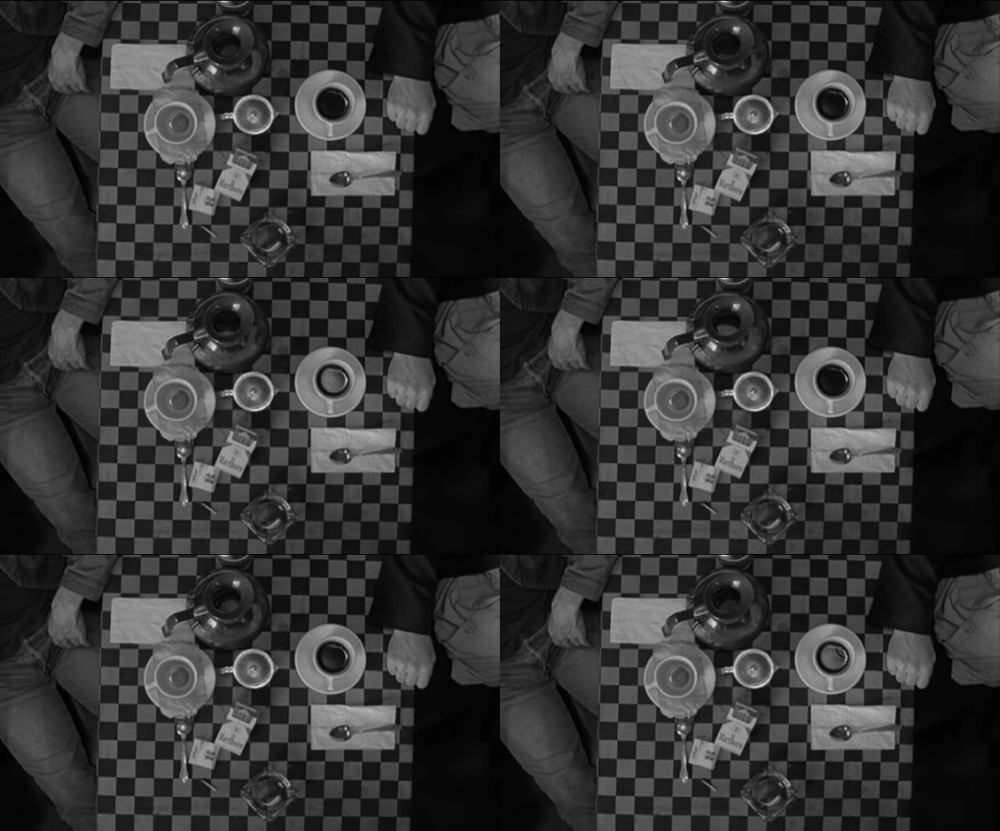
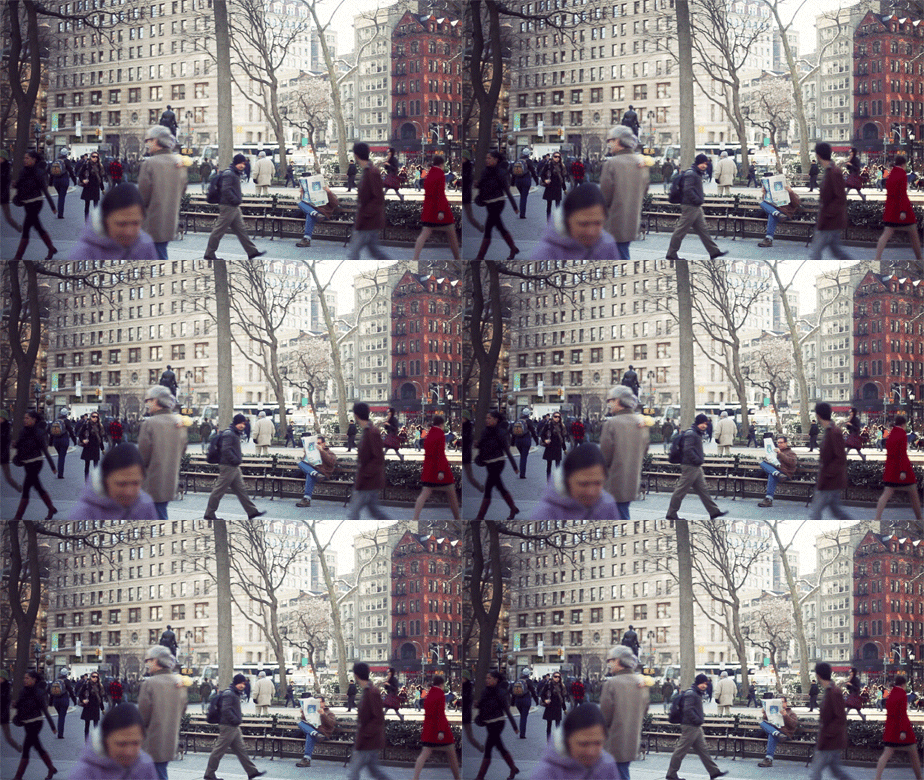
Second Year Students working on your blog posts: Here is a simple tutorial on how to create animated GIFs in Photoshop, with some example files you can download and try out:
Colònia Güell by Antoni Gaudí
Courtesy of Samuel Ludwig
Colònia Güell was a workers’ colony located in Santa Coloma de Cervelló, presently a town of around 7,000 inhabitants 20km outside Barcelona. The area was a manufacturing suburb that grew rapidly around the turn of the 20th century. In 1898, Antoni Gaudi was commissioned by Count Eusebi de Güell, who wanted to provide a place of worship for the booming suburb, to build a Church.
Through the construction process of Colònia Güell, Gaudi is said to have experimented with an array of techniques and architectonic details, many of which would later be used in his famous tour-de-force, the Sagrada Familia in Barcelona.
Courtesy of Samuel Ludwig
Brick and mosaics dominate the structure, used in an extraordinary way. The form of the building is anything but traditional, perhaps a by-product of the breath taking spaces, both interior and exterior. The crypt is magnificently articulated, changes in materiality carefully calculated and light sensitively controlled. Different bricks and stones are used for the structure, meeting at carefully detailed joints, and perhaps filling in different structural roles.
from archdaily
Labels:
architectural history,
brick,
structure
Subscribe to:
Posts (Atom)

.pdf+-+Adobe+Reader.bmp)